
By Laura Tierney, Vice President, International Programs, BCSE and Ignacio Fernandez, Senior Policy Advisor, The Climate Registry
Greenhouse gas (GHG) emissions accounting is becoming more consequential – and more complex. For many companies, reporting decisions influence capital allocation, procurement strategy, clean energy and fuels investment, and long-term decarbonization planning. Key standards and legislation are moving forward – with revisions to the Greenhouse Gas Protocol (GHGP) in progress, and August deadlines for entities in California reporting scope 1 and 2 emissions under SB 253.
With that context in mind, BCSE and The Climate Registry (TCR) hosted a workshop on the subject at the 2026 Climate Leadership Conference’s Carbon Disclosure and Decarbonization Forum. This workshop brought together practitioners to share information on what is changing, how it might affect corporate GHG reporting, and how companies can prepare. Carbon accounting has been foundational for both BCSE’s nearly 35 years of policy advocacy and TCR’s nearly 20 years of work aiming to bring California’s climate action model to the federal level.
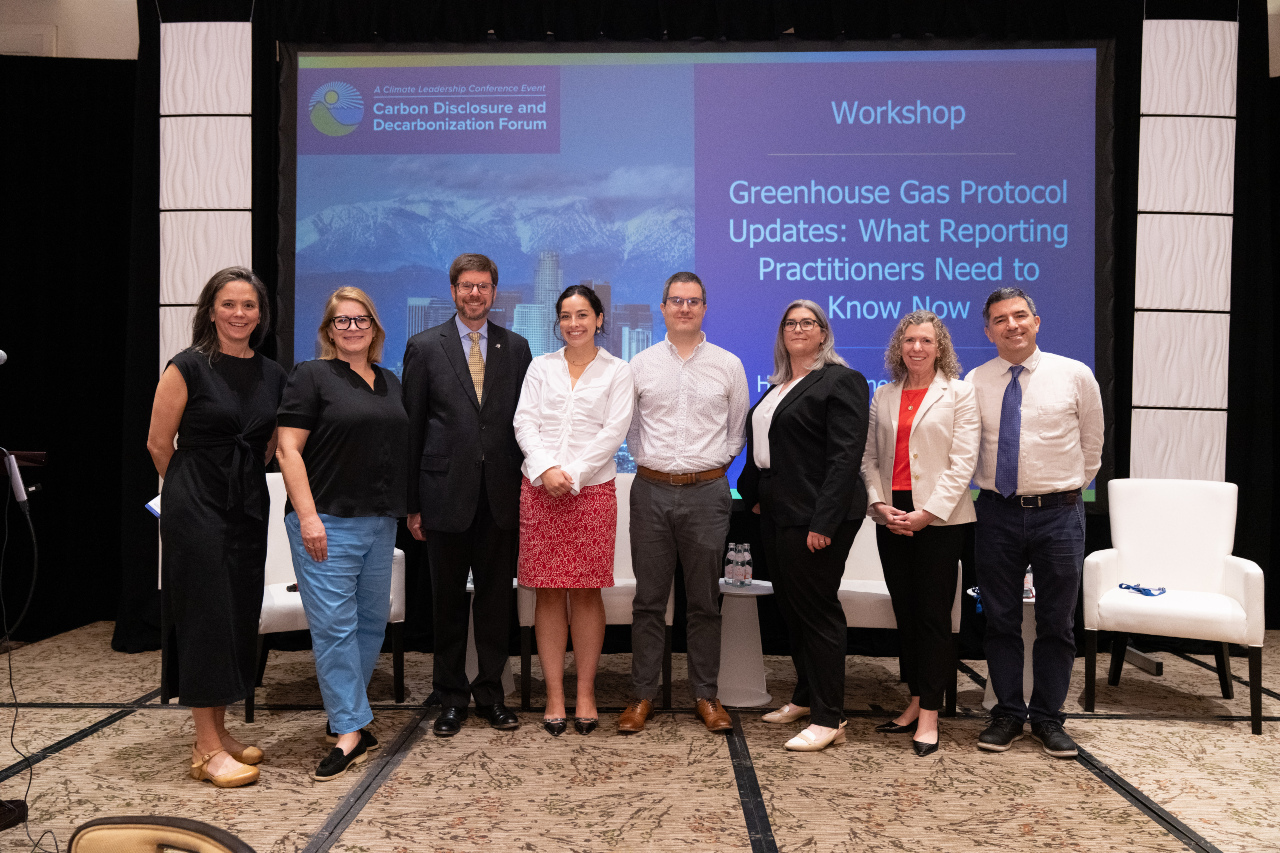
Above: BCSE and TCR host a workshop on the Greenhouse Gas Protocol Updates at the 2026 Climate Leadership Conference’s Carbon Disclosure and Decarbonization Forum.
TCR is one of several organizations actively participating in the process to update the GHGP standards and protocols. At the workshop, TCR provided an update on the timelines and proposed changes to the GHGP. Participants collectively explored topics such as:
- The proposed changes to Scope 2 emissions reporting under the GHGP
- The current state-of-play of Scope 3 emissions data collection, setting of boundaries, and areas for improvement
- The latest updates in GHG accounting for clean and sustainable fuels, as well as carbon dioxide removal technologies
Our top takeaways included:
1) The transition from voluntary to mandatory carbon reporting is well underway, and international standards, like the GHG Protocol, play a leading role in the business of GHG data collection and reporting.
2) Corporate carbon accounting and reporting is a continuous learning process – for the reporter, standard-setter, and the regulator. Technology, too, is evolving constantly and sometimes at greater speeds. The future will be iterative and will require interoperability of frameworks.
3) There is value in dialogue and sharing best practices across sectors, within industries, up and down the supply chain, and with governments and customers alike. This will likely remain true even as artificial intelligence holds the prospect of improving the efficiency and accuracy of GHG data collection and calculations.
Based on the conversations at the workshop and conference, we know that the bench of experience is deep when it comes to carbon reporting and frameworks. BCSE and TCR will continue to be a resource and convener in the evolving landscape for both practitioners and policymakers.
About the authors: Laura Tierney is the vice president of international programs for the Business Council for Sustainable Energy (BCSE). Ignacio Fernandez is a senior policy advisor for The Climate Registry. The Climate Registry is a nonprofit organization that empowers organizations to be climate leaders by providing best-in-class programs and services for measuring, verifying, disclosing, and reducing carbon emissions.