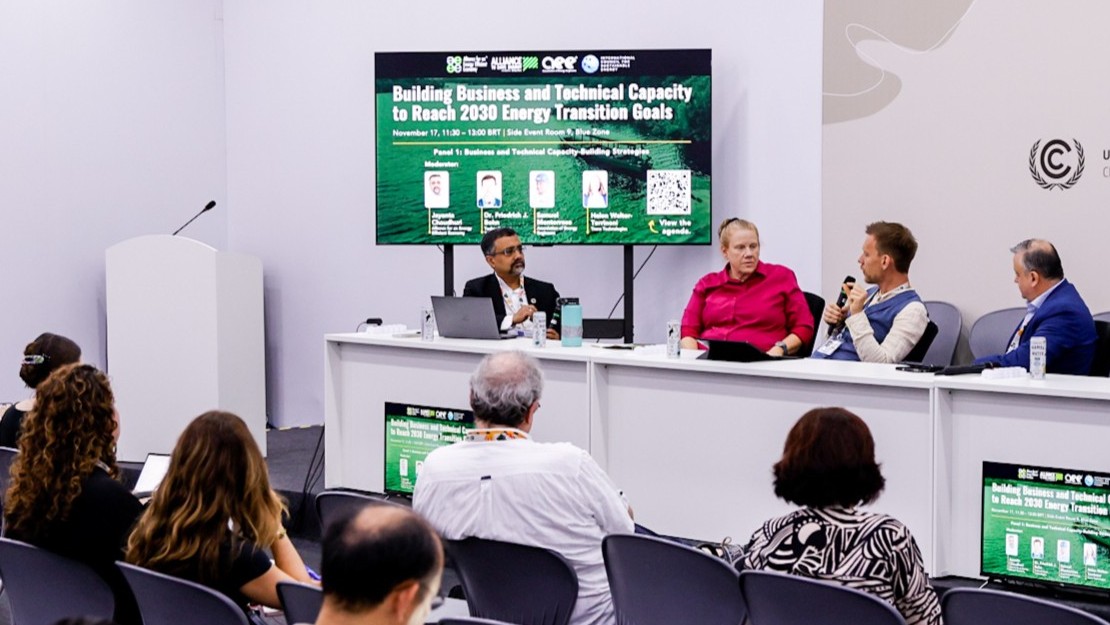
The International Council for Sustainable Energy (ICSE) co-hosted a UNFCCC side event in partnership with the Alliance for an Energy Efficient Economy, Alliance to Save Energy, and the Association of Energy Engineers on how to realize the Global Stock Take energy transition goals through energy efficiency and clean energy.
The side event discussed how a broad portfolio of energy efficiency and clean energy technologies across the built environment and power sector are needed to meet climate goals and rising energy demand. Panelists shared examples of successful partnerships to finance and deploy these solutions, as well as strategies for capacity building, workforce development, and improving energy access and affordability.
Agenda:
Panel One: Business and Technical Capacity-Building Strategies for workforce development, institutional readiness, and technology deployment
Moderated by Jayanta Chaudhuri, Director, Marketing, Alliances & Partnerships, Alliance for an Energy Efficient Economy (AEEE)
Speakers:
- Friedrich J. Bohn, Co-Founder, Bock auf Morgen
- Samuel Monterroso, Vice President for Latin America, Association of Energy Engineers
- Helen Walter-Terrinoni, Director, Global Policy and Advocacy, Center for Energy Efficiency and Sustainability, Trane Technologies
Key takeaways:
- Capacity-building will be central to COP30’s implementation agenda, ensuring countries can deliver on commitments.
- 2024 has been a strong year for renewable energy growth—but scaling requires institutional readiness and skilled labor pipelines.
- The narrative must shift from “green jobs” to “green careers,” emphasizing long-term opportunities and professional advancement.
- Energy cost concerns will increasingly shape the public conversation, making EE and workforce readiness even more relevant.
Trane Technologies:
- Key Barriers: Global shortage of trained technicians; high retirement rates. Technologies exist, but scaling requires workforce, enabling policies, and better installation quality.
- Regional Solutions & Policy: Broad policies are easy; local implementation is hard due to fragmented building codes. Need shared standards and stakeholder engagement.
- Workforce Programs: “Returnship” pathway for re-entering workers. Emphasis on community education, veterans hiring, and removing degree barriers (“Paper Ceiling”). 400+ people already certified; more growth planned.
- Who Must Move First? Companies can lead voluntarily. Any local entity—energy offices, trade schools, unions—can kickstart the skill-building cycle.
- Future Blind Spot: Growing global energy demand (especially AC in India). Consumers need to demand qualified installers.
Bock auf Morgen:
- Technology & Innovation: Developing carbon-negative construction materials using rock-based composites, carbon fibers from CO₂, and biochar. Advocates for a “silver machine gun”—multiple solutions, not one silver bullet.
- Scaling Challenges: Need faster testing frameworks and more government support. Building ecosystems and investor confidence is essential.
- Advice for Startups: Don’t fixate only on tech; improve marketing and understanding customer needs.
- Long-Term Vision: The building sector can reach carbon negativity. Replacing half of concrete could get the sector to net zero in 10–15 years.
- Future Blind Spot: Marketing and public engagement around clean tech is inadequate.
Association of Energy Engineers:
- On Certification: Certifications like CEM are vital for trust, competitiveness, and competence. But LATAM professionals often rely on employers/government to pay for them.
- Upskilling: Regulatory requirements drive certification uptake more than pride or pay. LATAM needs more investment and professional development infrastructure.
- Future Blind Spot: Shortage of renewable energy resources, materials, and trained personnel (including in government).
Panel Two: Financing and Partnerships that bridge investment gaps and accelerate measurable clean energy and energy efficiency outcomes
Moderated by Laura Tierney, Vice President, International Programs, Business Council for Sustainable Energy
Speakers:
- Mikael Melin, Director of Partnerships and Development, Sustainable Energy for All
- Bob Hinkle, President and CEO, Metrus Energy
- Steven Kukoda, Executive Vice President, Membership and Partnerships, International Copper Association
- Timothée Mace Dubois, Head of Sustainability Advocacy & Institutional Affairs, Global Sustainability, Schneider Electric
Key takeaways:
- Bankability is the central bottleneck: Upfront modeling, risk-sharing instruments, and creative financing structures are essential to convert pipelines into finance-ready projects.
- Partnerships drive scale: From public–private platforms to philanthropic capital, collaboration is required to unlock the $1.3 trillion needed globally.
- Skills and institutional capacity are as important as funding: Training and knowledge-building—especially in building systems and project development—unlock ongoing value.
- Energy efficiency’s value is multi-dimensional: Beyond savings, EE enhances resilience, productivity, indoor health, and economic performance—yet this broader value is often overlooked.
- Better storytelling and data transparency accelerate investment: Clear communication, simple metrics, and accessible data help align stakeholders and build confidence in efficiency solutions.
Sustainable Energy for All:
- Success Stories: Leveraging COP/G20 to elevate energy efficiency and secure commitments (e.g., doubling EE goal). Supporting countries with data, planning, and investment preparation.
- Key Needs: Better branding and storytelling (simplify, tell stories, add humor). Large energy access gaps remain—1 in 4 lack clean cooking.
- Future Vision: More frequent convenings and faster collaborative action. Plans to elevate EE in future high-level global processes.
International Copper Association:
- Success Stories: Creating the Energy Efficiency Marketplace to bridge finance and energy sectors. Work on grid efficiency in Africa; motor efficiency in Chile.
- Finance Challenges: Not enough bankable projects—only 1% of EE finance goes to capacity building. More work needed on forecasting models, stakeholder mapping, and project design.
- Future Needs: Governments must set minimum performance standards. Businesses alone won’t choose optimal efficiency without regulation.
Metrus Energy:
- Success Stories: Third-party financing becoming mainstream. Expanding into public sector: major airport geothermal project, new subsidiary for public financing.
- What’s Missing: Need to communicate broader business benefits—avoided downtime, reliability, aging equipment—not just energy savings.
- Future Outlook: Industry is recognizing the link between EE and grid reliability. COP helps build connectivity across sectors.
Schneider Electric:
- Success Stories: Microgrid deployment at JFK Terminal 1. Impact investment portfolio: €500M mobilized, 9,000 jobs, 12M tons CO₂ avoided. Investments in clean cooking and energy access companies.
- Training & Capacity Building: 60% of French BMS underperform due to lack of training. Schneider has trained 1M+, now targeting 5 million people in energy management across 60 countries.
- Future Need: Many more electricians and technicians worldwide. More startups and investors need presence at future COPs.
DETAILS