By Laura Tierney, Vice President, International Programs, BCSE
Last month, BCSE led a delegation of 20 U.S. businesses and clean energy trade organizations to the 30th Conference of the Parties (COP 30) to the United Nations Framework Convention on Climate Change (UNFCCC) held in Belém, Brazil. There, our business delegation hosted more than 15 events, sharing technology solutions with international partners and U.S. state and local leaders.
Today marks the 10th anniversary of the signing of the landmark Paris Agreement, and COP 30 demonstrated how the global conversation has advanced since then. This year’s climate conference advanced implementation of the Paris Agreement through the launch of a multi-year action agenda and the Global Implementation Accelerator. Collaboration among more than 194 countries – alongside strong participation from U.S. subnational leaders – underscores a sustained global commitment to reducing greenhouse gas emissions and strengthening climate resilience.
Here are BCSE’s top three reflections from our time at COP 30:
1. Global attention is shifting toward implementation and action. BCSE supports the pivot and Brazil’s call to bring “credible solutions, partnerships, investments, and ideas” to the COP.
COP 30 marked three decades of inter-governmental negotiations on climate change. It also marked the 10-year anniversary of the signing of the Paris Agreement – the landmark international treaty that set a goal of keeping the global average temperature well below 2°C above pre-industrial levels and limiting global warming to 1.5°C above pre-industrial levels.
At this point, many negotiations have been completed. In the past two years alone, countries agreed to new energy transition goals and submitted updated national climate plans. Now, global attention is justifiably shifting to what is being done to meet these goals. As COP 30 President, Brazil signaled a new era by elevating to center stage the Global Climate Action Agenda, which focused on implementation by the private sector and subnational governments.
BCSE contributed to pragmatic conversations around advancing the energy transition by bringing private sector insights and examples to the table. Our business leaders demonstrated what is possible – deploying demand-side energy efficiency solutions, modernizing existing infrastructure, building supply-side clean energy. BCSE members offered expertise around net-zero utilities, sustainable fuels and transport corridors, and the built environment and cities. A snapshot of these case studies can be found in our Granary of Solutions.
2. Global support of the energy transition goals persists, with the addition of a new goal for sustainable fuels.
COP 30 saw the signing of a new Belém 4X Pledge on Sustainable Fuels, led by Brazil and supported by 23 additional countries. This pledge sets a goal of quadrupling the production and use of sustainable fuels by 2035. The milestone reflects industry input and is an essential step toward building political support for decarbonizing hard-to-abate sectors like aviation and maritime transport through the production of biofuels, biogas, synthetic fuels, and hydrogen.
The suite of energy transition goals now agreed upon by the international community also includes doubling the average annual rate of energy efficiency improvements, tripling renewable energy capacity, and increasing energy storage deployment sixfold by 2030.
At COP 30, BCSE led the push for meeting this global energy efficiency goal. Together with the Alliance to Save Energy, BCSE delivered to the Brazil Presidency a letter signed by 180 U.S. businesses and organizations pledging their continued support for energy efficiency. This letter was highlighted in the official Global Climate Action Agenda outcomes report as a key solution for transitioning energy, industry, or transport.
Notably, the suite of energy transition goals also includes a pledge to transition “away from fossil fuels in energy systems, in a just, orderly and equitable manner, accelerating action in this critical decade, so as to achieve net zero by 2050 in keeping with the science.” Progress on this goal was a key discussion point at COP 30, as more than 80 countries called for an official “transition away from fossil fuels” (TAFF) roadmap. Ultimately, the final text made no direct mention of fossil fuels, but plans were made for a conference in April 2026 hosted by Colombia and the Netherlands that will continue this conversation.
Together, these goals act as a guiding North Star for governments and businesses alike. BCSE members will continue deploying a broad portfolio of energy efficiency, renewable energy, storage, and sustainable fuels solutions on the ground to deliver progress while improving energy access and creating new jobs around the world.
3. COP 30 introduced us all to the spirit of mutirão, and that the heart of climate action is local. For BCSE, this starts with public-private partnerships.
For BCSE, embracing the spirit of mutirão – or collective action – starts in finding partnerships at the state and local levels of government that can facilitate working with local communities and investing in workforce development.
At COP 30, it meant working with more than 100 U.S. state and local leaders – led by America is All In, the U.S. Climate Alliance, and Climate Mayors – who traveled to Brazil to attend the Local Leaders Forum in Rio de Janeiro. Many of these leaders later attended COP 30 in Belém as part of The Climate Registry’s delegation and were featured speakers at the U.S. States’ Action on Climate (USA Climate) Pavilion.
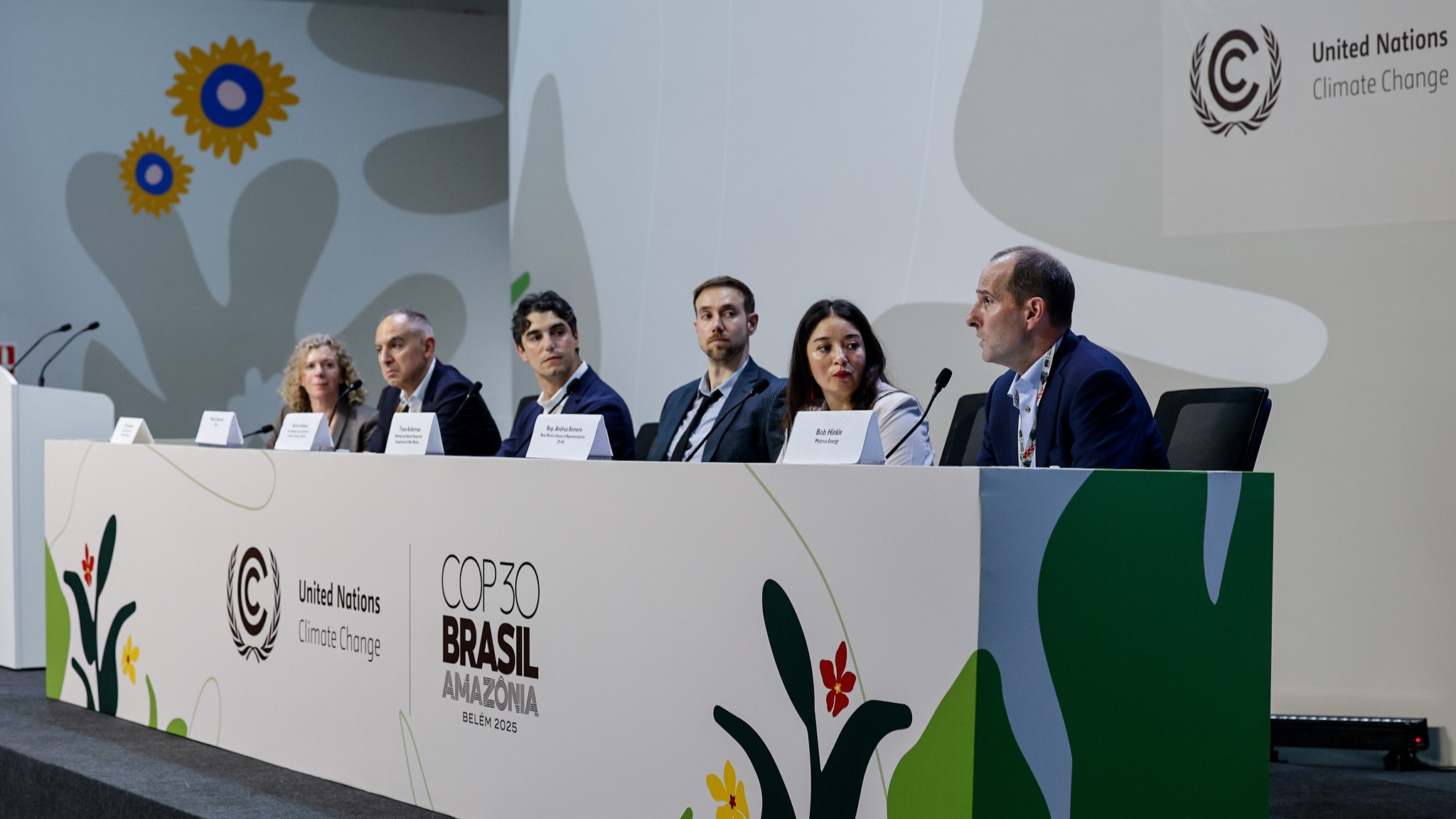
BCSE was pleased to co-host an official UNFCCC side event featuring U.S. sub-national leaders from California, New Mexico, and Tennessee, alongside private sector executives that are committed towards delivering climate ambition across the country. Plus, BCSE’s press conference seated public and private leaders side by side to share solutions for meeting energy transition goals in the United States.
This work with state and local leaders is key to driving down U.S. emissions. Research released just prior to COP by America Is All In and the UMD Center for Global Sustainability demonstrates that significant cuts to greenhouse gas emissions by the United States – up to 56% – are still achievable by 2035 through ambitious climate action from state, city, and local governments.
BCSE looks forward to working with international and U.S. subnational partners to further progress in 2026 and encourage Türkiye and Brazil to continue to build out this central role for the Action Agenda at COP 31 in Antalya.
About the Author: Laura Tierney is the Vice President of International Programs for the Business Council for Sustainable Energy.