
By Jennifer Layke, Executive Director, American Council for an Energy-Efficient Economy (ACEEE) and Lisa Jacobson, President, BCSE
The United States is in an era of unprecedented load growth. Forecasts suggest electricity consumption could rise 20–50% over the next decade, with peak demand up 19–35% in both summer and winter. Data centers, new manufacturing, and the electrification of transportation and buildings are all driving the surge.
At the same time, electricity bills are climbing: U.S. residential electricity prices have risen 32% over the past decade, and wholesale prices spiked sharply in 2025, with increases of 45–62% in major Northeast and Mid-Atlantic markets. The affordability pressure is real, and it demands a response that puts cost-effectiveness first.
As utilities, hyperscalers, and manufacturers rush to find new energy sources, they must look at the diverse portfolio of available demand- and supply-side solutions. Many technologies are fast to deploy and will help put downward pressure on electricity bills.
Specifically, more focus should be placed on a strategic reserve already in the system, and the opportunity to alleviate the crunch for consumers and the grid: energy efficiency and load flexibility. Efficiency is often painted as yesterday’s idea – and limited to things like weatherization. But in today’s high-tech appliance world, a combination of sensors and controls alongside batteries, electric vehicles, and more opens far more options for a more dynamic, efficient suite of demand-side efficiency options – and their lower price tag can help reduce the scale and effect of expensive new power plant investments.
The American Council for an Energy-Efficient Economy (ACEEE) analyzed the nation’s largest utility programs, and the data show that energy efficiency delivers savings of about $21 per megawatt-hour, and demand flexibility programs reduce peak demand for less than $40. These are the lowest-cost options – and they can be deployed faster than any new power plant. But demand-side actions don’t show up in most analyst assessments.
The cheapest resources on the table
The 2026 Sustainable Energy in America Factbook, published by the Business Council for Sustainable Energy (BCSE) and BloombergNEF, provides useful context on the cost of supply-side alternatives.
The Factbook’s benchmark levelized cost of electricity (LCOE) – which excludes subsidies, tax credits, or grid-related and system costs – reveals that renewables are among the cheapest generation sources to build. Costs come in at $61/MWh for onshore wind, $61/MWh for utility-scale solar PV, $66/MWh for combined-cycle natural gas, and $171/MWh for coal. As such, it is not surprising that renewables accounted for 61% of new power-generating capacity in 2025, with utility-scale solar leading with 27 GW of alternating current capacity commissioned.
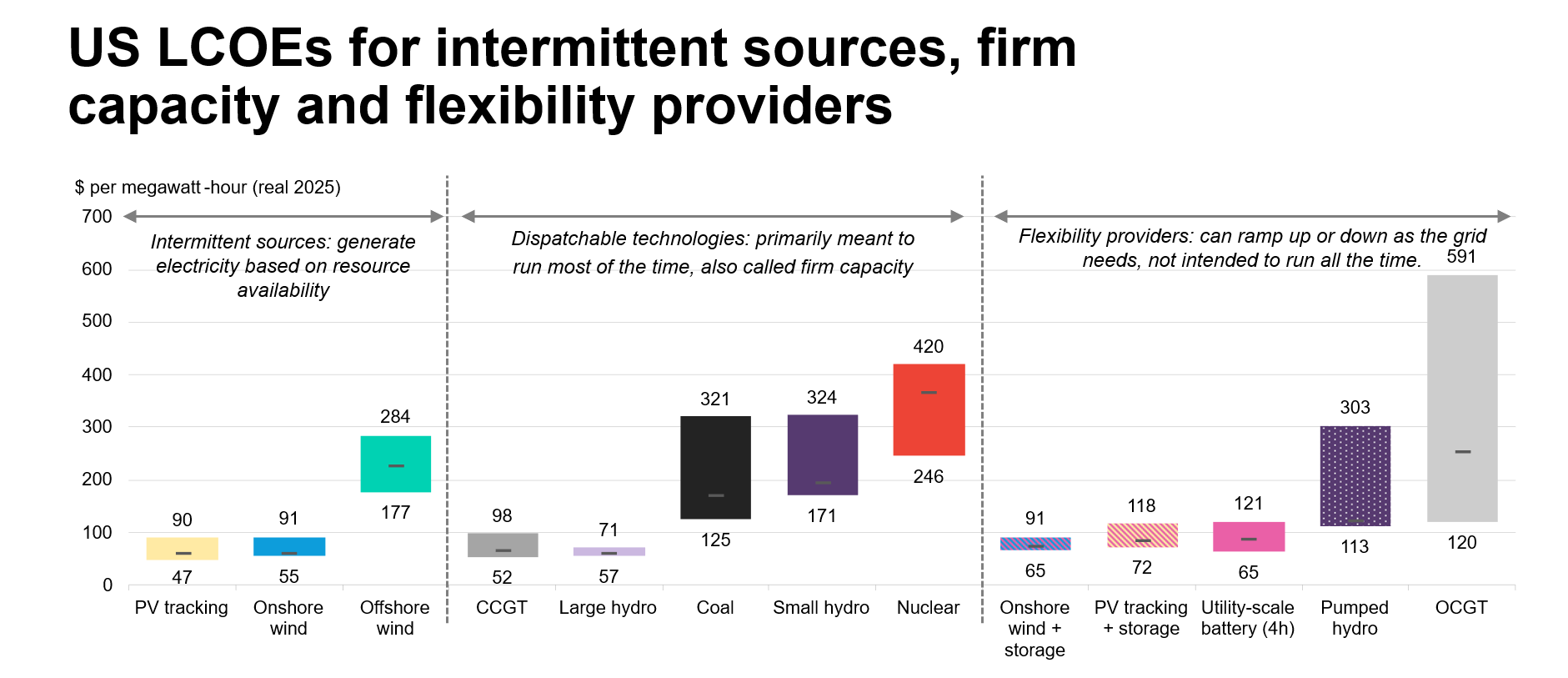
Planners have long looked at LCOE as a useful benchmark. It measures the cost of generating a unit of electricity from each specific technology.
However, demand- and supply-side solutions are not often compared together, resulting in missed opportunities to lower costs for consumers and increase grid capacity.
Distribution system costs are often not included in LCOE calculations. Efficiency savings can improve the affordability for the entire system.
It makes economic sense to blend maximum efficiency and demand flexibility into any new investment in power generation – protecting consumers and improving power system performance at the same time.
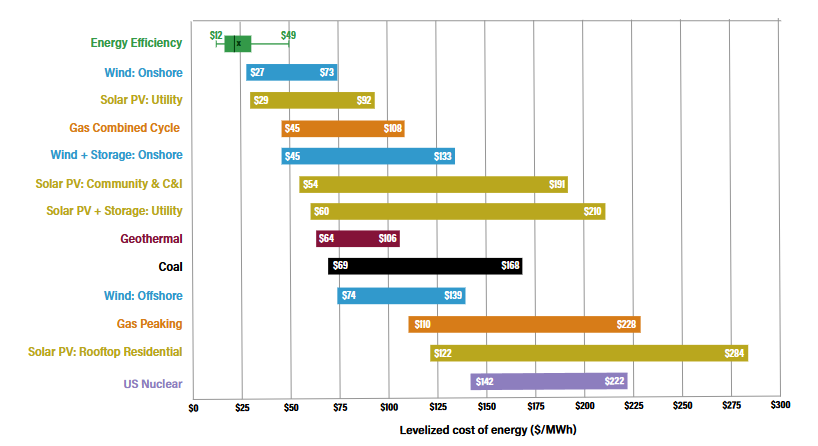
Source: Faster and Cheaper: Demand-Side Solutions for Rapid Load Growth (2026). A comparison of the levelized cost of energy efficiency and supply-side resources. Vertical line and “X” represent the median and mean costs of energy efficiency, respectively. Cost data for supply-side resources calculated by Lazard (2024).
In an era of volatile global energy markets, demand-side resources also reduce consumers’ exposure to fuel price swings and supply disruptions. Efficiency strengthens domestic energy security by reducing the demand that makes the economy vulnerable in the first place.
Fast to deploy, better for the grid
Cost is only half the argument. Speed matters just as much when load growth is accelerating. Virtual power plants – networks of distributed energy resources coordinated to reduce or shift demand – can be operational in six months, while supply solutions can take more time to come online.
Demand-side resources can also be targeted to the specific locations where load growth is creating the most strain, without entering those lengthy permitting and interconnection queues. By reducing and shifting load, they free up capacity on existing infrastructure and help accommodate large new loads without creating distribution bottlenecks. That grid headroom improves resilience for all customers.
Equally important, demand-side measures are a “no-regrets” option. With uncertainty around the scale and location of the build-out of data centers, efficiency and load flexibility buy time, reduce risk, and deliver value to participating customers and other ratepayers, regardless of how load growth plays out.
Current deployment is not keeping pace
Despite these advantages, the nation is not scaling demand-side resources fast enough. The Factbook reports that electric utilities saved 21.7 terawatt-hours through efficiency programs in 2024, and utility efficiency spending rose to $8.4 billion. States with energy efficiency resource standards (EERS) in place accounted for 62% of U.S. electricity sales.
But there is more opportunity that has not been tapped. Only 6% of U.S. energy consumers participated in a retail demand response program in 2024, underscoring the scale of the opportunity. Nationally, energy efficiency alone has the realistic potential to reduce electricity consumption by about 8% and demand by roughly 70 gigawatts by 2040. Experts estimate that 60–200 GW of additional load flexibility potential is available within the next decade.
The cheapest, fastest path to meeting load growth starts with using today’s grid better and offering a “no-regrets” option until new capacity can be brought online. Demand-side resources lower costs for ratepayers, reduce risk for utilities, and strengthen the reliability of the system we already have.
Energy efficiency should not be treated as an add-on to resource planning. It should be treated as critical infrastructure and a strategic resource to tap.
For a deeper look at these and other demand-side strategies, see ACEEE’s Faster and Cheaper report and BCSE’s 2026 Sustainable Energy in America Factbook.
About the authors: Lisa Jacobson is the president of BCSE. Jennifer Layke is the executive director of the American Council for an Energy-Efficient Economy (ACEEE). ACEEE is a nonprofit research organization that develops transformative policies to reduce energy waste and combat climate change.