New Study Shows Sustainable Energy Technologies Met Rising Demand Growth in 2025 Despite Uncertainty
Fourteenth Sustainable Energy in America Factbook highlights national data on the U.S. energy expansion in 2025
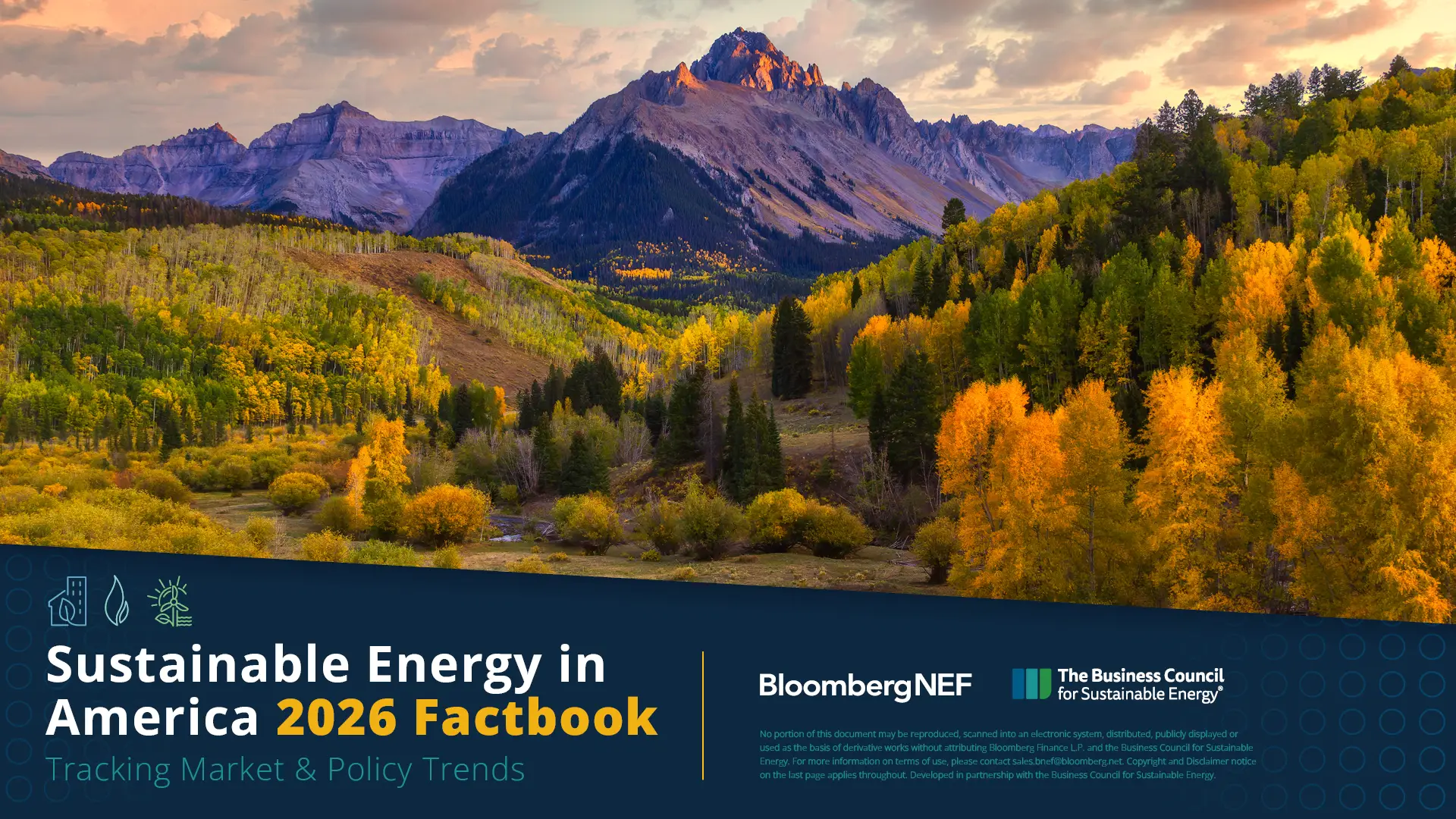
Washington, D.C. – In 2025, U.S. electricity demand rose considerably for the first time in decades, coinciding with rising electricity prices. At the same time, far-reaching and unpredictable policy changes provided both major challenges and a few unanticipated opportunities for the energy sector, according to the 2026 Sustainable Energy in America Factbook published today by BloombergNEF (BNEF) and the Business Council for Sustainable Energy (BCSE).
Wholesale and retail power prices both increased in 2025, concurrent with a renewed political focus on energy affordability. Overall, retail demand for electricity climbed 2% year-on-year in 2025 and was up 8% over the past decade following more than a decade of near-flat electricity demand. But despite major headwinds, a diverse mix of energy sectors – including energy efficiency, renewable energy, energy storage, natural gas, and sustainable transportation – continued to grow across the country, driving U.S. power generation to a 20-year high.
“2025 was a significant year for U.S. energy industries, with impactful market and policy changes that have altered the trajectory for all sectors,” said BCSE President Lisa Jacobson. “These fast-moving dynamics provide an opportunity to accelerate investment into a broad portfolio of sustainable energy technologies. This diverse set of resources will allow the U.S. economy to prosper, boost national security and economic competitiveness, and deliver reliable and affordable energy for all Americans.”
Reshaping the Energy Landscape: Data Center Demand Has Quintupled in the Past 10 Years
The 2026 Factbook reports that data centers are now a dominant force behind rising U.S. power demand and the associated impact on the grid. They are also increasingly under scrutiny for rising electricity prices.
Data center electricity demand has grown more than 400% in the past 10 years and 150% in the last five years. Development shows no signs of slowing. Through the first quarter of 2025, a cumulative 23 gigawatts (GW) of data center IT capacity was live in the United States with 48 GW under construction or committed to be built.
Across the entire U.S. economy, total primary energy consumption ticked up 1.2% in 2025 but was outpaced by GDP growth of 2%. This is a direct result of decades-long investments in energy efficiency technologies, which have allowed consumers to save billions of dollars while improving U.S. economic competitiveness.
Amid data center load growth and a broader political focus on affordability, electricity costs are increasingly top of mind for policymakers. Wholesale power prices increased sharply in the natural gas-heavy Northeast and Mid-Atlantic, reflecting higher gas prices, pressure on capacity markets, and grid constraints. Prices rose 62% year-on-year in New York State, 60% in New England, and 45% in the PJM power market that stretches across 13 states and the District of Columbia. Despite growing focus on specific markets, retail prices nationally inched up just 2.3% year-on-year. Over the past decade, U.S. residential electricity prices have risen 32%.
“As demand from energy-hungry data centers continues to grow, we’ll likely continue to see upward pressure on power prices,” said Ethan Zindler, BloombergNEF’s Head of Country and Policy Research. “The need to expand supply from sustainable energy sources has never been clearer.”
Despite Major Headwinds, Sustainable Energy Technologies Continued to Expand
The United States built the most new power-generating capacity in more than two decades in 2025 with 54 GW of new utility-scale generation and storage capacity commissioned. Renewables accounted for 61% of new capacity, with utility-scale solar specifically leading with 27 GW alternating current commissioned. Utility-scale energy storage emerged as a central component of new capacity, with a record 15 GW added in 2025, up 35% year-on-year. Natural gas capacity additions also doubled year-on-year.
U.S. investment across all of the energy transition sectors BloombergNEF tracks – including renewables, electrified transport, decarbonization of industrial processes, and grids, among others – grew 3.5% year-on-year to a record $378 billion. Corporate power purchase agreements signed for zero-carbon electricity reached 29.5 GW in 2025, the highest annual total on record. Last year was marked by a growing share of nuclear, hydropower, and geothermal contracts as tech giants doubled down on clean, baseload power for AI data centers.
EV sales reached a record 1.6 million vehicles in 2025, 3.7% higher than 2024, reflecting consumer uptake ahead of the phaseout of federal tax credits in October 2025. With the push to add new electric generation, capital deployed to support expansion and reinforcement of the grid also rose to a record $115 billion in 2025.
“The need for electricity infrastructure is growing rapidly with rising EV sales and the AI data center build-out,” said Trina White, BloombergNEF’s Senior Associate, North American Energy Transition. “This is creating some supply chain bottlenecks while raising the costs for key grid equipment. Even amid significant policy incentive rollbacks and regulatory obstacles, these structural demand drivers are continuing to drive growth in the sector.”
Business Certainty Needed for Speedy Deployment
The growth in energy investment and deployment in 2025 came even as the industry grappled with uncertainty driven by federal policy changes. No less than 87 new U.S. trade and tariff policies were announced in 2025, creating unpredictability for companies and investors with exposure to cleantech supply chains. Businesses relying on the 10-year timeline of federal tax incentives enacted in 2022 had to adjust development plans as many credits were abruptly phased out in late 2025. In addition, federal permitting revocations and restrictions, especially impacting wind and solar projects, have added additional delays to already lengthy approval timelines.
The slow pace at which infrastructure projects can secure necessary permits and advance remains a key obstacle for energy deployment. In 2025 alone, 377 GW of new capacity applied to interconnect in the seven U.S. independent system operators, with energy storage projects making up the majority. It can take years for these projects to connect to the grid and bring power online. From transmission rights-of-way to carbon sequestration, reforms to federal permitting and siting regulations could help alleviate these difficulties and accelerate the pace of the U.S. energy expansion.
“Businesses are ready to deploy solutions to meet energy demand, but they need certainty that policies and permits will not change once commitments to long-term energy sector investments have been made,” said BCSE President Lisa Jacobson. “The United States can capitalize on this momentum through long-term policy and regulatory reforms, such as enacting permitting reform and continuing investment in innovation through RDD&D initiatives.”
Comprising more than 60 slides with data visualizations, the 2026 Sustainable Energy in America Factbook is a comprehensive resource that highlights the state of the U.S. energy industry based on statistics and data inputs from the year before. In addition to highlighting the contributions of key energy sectors in 2025, the Factbook details important market and investment dynamics, technology trends, and policy developments.
Download the complete 2026 Sustainable Energy in America Factbook at bcse.org/factbook.
Media Contacts
| Lizzie Stricklin Business Council for Sustainable Energy lstricklin@bcse.org |
Oktavia Catsaros BloombergNEF ocatsaros@bloomberg.net |
About the Factbook Partners
BloombergNEF (BNEF) is a strategic research provider covering global commodity markets and the disruptive technologies driving the transition to a low-carbon economy. Our expert coverage assesses pathways for the power, transport, industry, buildings, and agriculture sectors to adapt to the energy transition. We help commodity trading, corporate strategy, finance, and policy professionals navigate change and generate opportunities.
The Business Council for Sustainable Energy (BCSE) is a coalition of companies and trade associations that deploy clean energy and decarbonization solutions, with a sector focus on energy efficiency, natural gas, and renewable energy. The coalition advocates at the federal level for policies that advance the deployment of a broad portfolio of clean energy technologies. Established in 1992, BCSE members include investor-owned utilities, public power, independent power producers, project developers, technology providers, equipment manufacturers, environmental and energy market service companies, and more.