In the spirit of the COP 30 Presidency’s call for a global mutirão – a collective effort to mobilize climate action – the Business Council for Sustainable Energy (BCSE) will lead a business delegation to COP 30 in Belém, Brazil that will bring forward credible solutions, partnerships, investments, and ideas to accelerate the energy transition and decarbonize agriculture, buildings, industry, and transportation. This case study is part of BCSE’s Granary of Solutions to deliver emissions reductions, increase resilience, and meet energy transition goals worldwide.
Highlights:
- A pilot program in Kenya retrofitted 100 boarding schools with energy-efficient LED lighting
- Data collected in pilot phase demonstrates benefits such as improved well-being and productivity, reduced energy consumption by 40–50%, and cost savings ranging from $100 to $200 per month
- With approximately 3,500 boarding schools and other public infrastructure in need of similar upgrades, Kenya is well-positioned to scale up energy efficiency projects
Case Study:
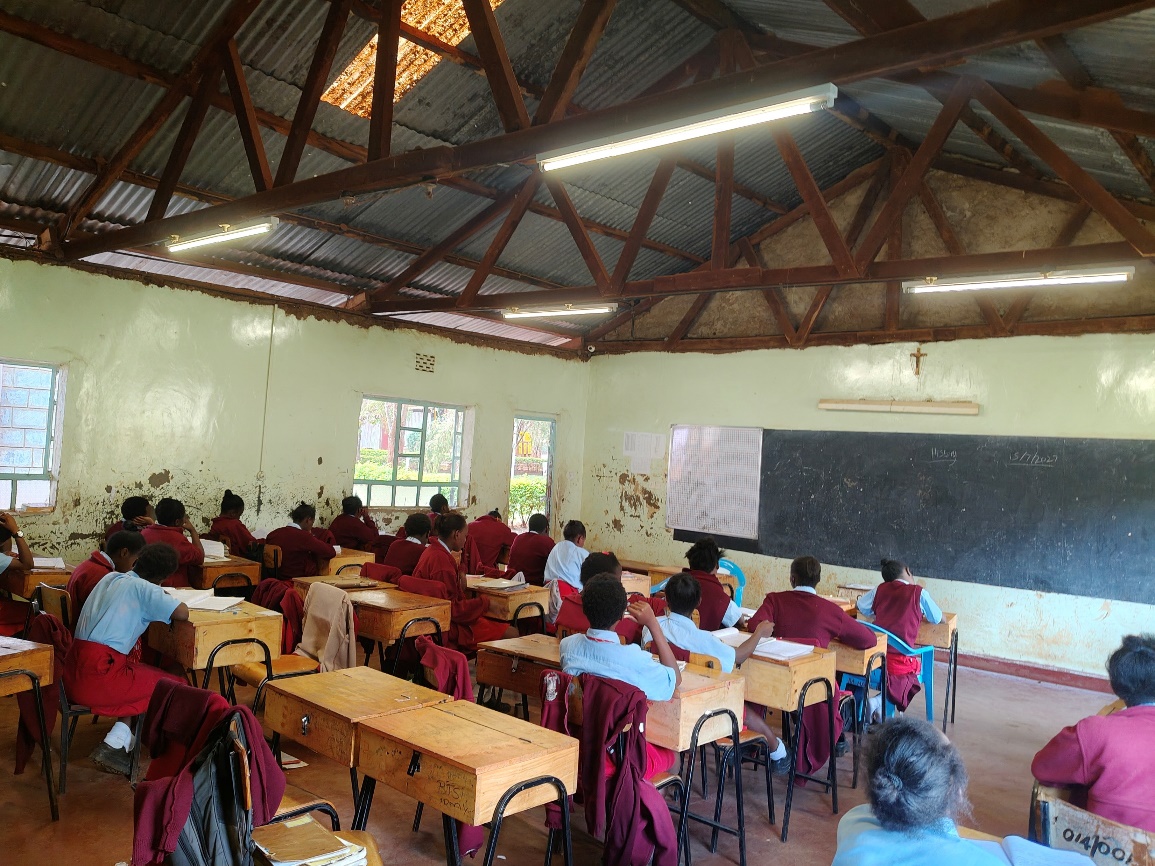
The Signify Foundation, UNEP-CCC, Sustainable Energy for All, the Kenya Ministry of Energy and Petroleum, and key collaborators have successfully concluded the pilot phase of the Powering Education project in 100 Kenyan schools, which seeks to develop and implement a model for transitioning schools to energy efficient lighting.
Globally, 25% of primary schools and about 15% of secondary schools lack access to electricity, affecting 186 million children. Energy-efficient lighting contributes to creating a better learning environment in schools. Well-lit classrooms enhance visibility, reduce eye strain, and foster a more conducive atmosphere for teaching and learning. Increasing the use of LEDs in lieu of incandescent and fluorescent technologies leads to substantial cost savings, freeing up resources that can be reinvested in other needs for the school children.
LED lighting’s rise in efficiency and affordability makes them the most cost-effective artificial lighting solution for existing and new buildings, from schools to homes. Scaling up, however, presents challenges, particularly financing upfront investments in developing countries.
The pilot phase aimed to demonstrate the feasibility of a large-scale lighting replacement program in secondary boarding schools, establish the baseline for energy-efficient practices, quantify the lighting requirements in schools, and identify key barriers to implementation.
Stakeholders from various government ministries and the private sector agreed on a methodology for school selection and further conducted data collection and analysis of electricity consumption in 100 schools across Kenya’s 47 counties, prioritizing schools with at least 10 years of operation, high occupancy rate, and high electricity consumption. This phase culminated with a high-level holistic energy consumption audit with findings that the schools would need to retrofit more than 25,000 light fittings benefiting more than 100,000 students.
Key findings from the visit to schools:
- Lighting is a major consumer of electricity, in addition to water pumping, for most schools. Yet schools are not well lit. Poor lighting is a result of building designs that inhibit natural light and hence the lights must be turned on during the day.
- Only 7% of the schools have installed LEDs, and capacity building and sensitization are needed on energy efficiency and conservation practices among students and teachers.
- Nearly every school reported a struggle with power outages, which disrupted learning at night and compromised security especially where back-up generators are faulty or there are no back-up options with some schools using solar home systems as back-up.
- 90% of the schools prioritize lighting around the perimeter and classrooms for security. 78% of schools visited lacked electricity sub-meters.
- Over 40% of the light fittings found were traditional fluorescent 36W lamps, while 3% were incandescent bulbs.
- Energy efficiency opportunities identified in schools relate to day lighting and passive cooling solutions, solar systems for water pumping, efficient equipment, motors and cook stoves to replace existing firewood.
“Our joint effort in Kenya extends beyond the provision of lighting fixtures; it is a commitment to guiding these students towards a brighter tomorrow,” said Eric Otieno, Project Manager at Signify Foundation, who donated LED and solar lighting for this pilot. “Through our focus on providing energy-efficient lighting that also meets the needs of students’ learning activities, we’re laying the foundation for a sustainable healthy educational environment in these schools. The data collected from 100 secondary schools serves as a valuable baseline for our initiative, that we hope will serve as a replicable model for the entire country.”
“Through the Mission Efficiency ecosystem, this is one of the efforts taken to domesticate doubling energy efficiency in Kenya and the opportunity is to scale up across all learning institutions as a minimum,” said Elizabeth Wangeci Chege, Energy Efficiency and Cooling Specialist at Sustainable Energy for All (SEforALL) , a project partner. “To create an optimal learning environment, schools should prioritize natural light where possible and consider energy-efficient LED lighting. Remembering that investing in quality lighting benefits everyone in the educational ecosystem.”
“The school lighting project exemplifies the essence of multi-stakeholder partnerships, showcasing the critical role they play in driving sustainable change,” said David Mutisya, Senior Deputy Director of Renewable Energy at the Ministry of Energy in Kenya. “It is a significant stride towards the implementation of the Kenya National Energy Efficiency and Conservation Strategy, highlighting the urgent necessity for investment, strategic partnerships and capacity building to tackle the challenges posed by inefficient lighting and the need to extend our vision to encompass all energy uses in our educational institutions. This initiative not only illuminates the path to a brighter future for our students but is also a catalyst for broader energy efficiency and conservation measures across the nation.”
Energy-efficient lighting has a direct benefit on students and teachers, and communities more broadly. Globally, increasing the use of efficient lighting technologies and implementing passive strategies like maximizing daylight through correct building orientation, correct window sizing, and glazing selection are key to doubling the global average annual energy efficiency improvement rate by 2030.
The Powering Education project is putting these technologies and principles into practice. Project partners will now work together over the coming months on the delivery of the LED light fittings in the schools, retrofitting, electronic waste management and performance monitoring.
SEforALL is supporting the project through its in-country staff, interns, and trainees who are participating in its STEM Traineeship, which seeks to provides hands-on experience to young women looking to grow their careers within the sustainable energy sector. Their continued involvement will be instrumental during the project’s installation, monitoring, and evaluation phases.
Separately, partners will be working to establish Minimum Energy Performance Standards for school lighting and financial mechanisms to support the uptake of efficient technologies in schools and other sectors, notably through the Mission Efficiency Marketplace.